Soil Monitoring: How Sensors and Soil Tests Improve Farm Decisions
Soil monitoring combines field observation, soil moisture and other sensor readings, and periodic soil testing to help farmers track changing conditions and make better irrigation, nutrient, and soil-management decisions.
Soil monitoring is the repeated observation and measurement of soil conditions so farmers can see how a field changes over time and respond before problems become severe. A useful monitoring system can combine soil moisture and temperature sensors, electrical conductivity readings, field observations, weather information, and periodic laboratory tests for pH, nutrients, organic matter, and other indicators.
The goal is not to collect as much data as possible. It is to track the indicators that influence real farm decisions such as irrigation timing, nutrient management, salinity control, soil-health improvement, and crop-stress investigation.
What is soil monitoring?
Soil monitoring means measuring selected soil indicators repeatedly and comparing the results over time, between field zones, or against a useful baseline. USDA NRCS explains that soil health cannot be understood from a single measurement. Instead, farmers use physical, chemical, and biological indicators to understand how well the soil is functioning.
Monitoring differs from a one-time soil assessment. An assessment describes conditions at one moment. Monitoring looks for trends: is the root zone drying faster than expected, is salinity increasing, is pH moving outside the desired range, or are management changes improving soil function?
What should farmers monitor in soil?
The right indicators depend on the crop, soil, climate, irrigation system, and management objective. Not every field needs every sensor. The following measurements are among the most useful.
1. Soil moisture
Soil moisture is one of the most practical variables to monitor because it changes quickly and directly affects irrigation decisions. Moisture sensors can help estimate how much water remains in the root zone and how fast the soil dries after irrigation or rainfall.
Common systems measure either volumetric water content or soil water tension. Volumetric sensors estimate how much of the soil volume is water. Tension sensors estimate how difficult it is for roots to extract that water.
Moisture data is most useful when interpreted with soil texture, root depth, crop stage, field capacity, recent rainfall, and irrigation-system performance rather than as a universal percentage.
2. Soil temperature
Soil temperature influences seed germination, root development, microbial activity, and nutrient cycling. It can also help explain why crop development differs between field zones or seasons.
Temperature is often measured by the same probes or stations used for moisture monitoring. The useful range depends on the crop and growth stage, so trends and local agronomic thresholds matter more than one generic target.
3. Soil pH
Soil pH describes acidity or alkalinity and strongly influences nutrient availability and biological activity. It is an important soil-health indicator, but it usually changes more slowly than moisture and is commonly measured through periodic field or laboratory testing rather than treated as a minute-by-minute variable.
Portable meters can be useful for screening, but calibration, sampling method, soil-water ratio, and equipment quality affect results. Important fertilizer or liming decisions should use an appropriate soil-testing method for the local crop and soil.
4. Electrical conductivity and salinity
Electrical conductivity (EC) is used as an indicator of soluble salts in soil. Increasing salinity can reduce a plant's ability to take up water and may become a serious constraint in irrigated agriculture.
Some soil probes measure EC together with moisture and temperature. EC readings must be interpreted carefully because soil moisture, temperature, texture, and the measurement method can influence the value. A trend across the same locations can often be more informative than comparing isolated readings from different methods.
5. Nutrient status
Nitrogen, phosphorus, potassium, and other nutrients are essential to crop performance, but nutrient monitoring is different from moisture monitoring. A simple continuous field probe does not replace a properly collected soil sample and laboratory analysis for fertilizer planning.
Nutrient availability can change with pH, moisture, temperature, crop uptake, fertilizer timing, and soil biology. Farmers should use soil and, when appropriate, plant-tissue testing according to local agronomic recommendations.
6. Organic matter and biological indicators
Soil organic matter, soil respiration, microbial activity, earthworms, aggregate stability, infiltration, and other indicators can help describe longer-term soil function. These do not normally need continuous electronic monitoring.
They are especially useful when the objective is to evaluate whether practices such as cover crops, reduced disturbance, organic amendments, or diversified rotations are improving soil health over several seasons.
What types of soil sensors are used on farms?
There is no single “soil health sensor” that measures everything reliably. A soil monitoring system normally combines different tools.
Volumetric water-content sensors
Capacitance, frequency-domain, and time-domain reflectometry sensors estimate soil water content from the electrical properties of the soil. They can provide rapid readings and can be connected to data loggers for remote monitoring. Accuracy depends on sensor type, installation, soil conditions, and calibration.
Soil-water tension sensors
Tensiometers and granular-matrix sensors estimate how strongly water is held by the soil. They can be useful for irrigation scheduling because they relate more directly to the effort roots need to extract water, but operating range and accuracy vary with soil type and sensor technology.
EC and temperature probes
Some probes combine moisture, temperature, and electrical conductivity in one device. These are useful for tracking changes in the root zone, but EC should not be interpreted as a direct nutrient reading.
Portable meters and field tests
Handheld pH or EC meters, soil probes, infiltration tests, and visual assessments can add useful information without installing permanent sensors everywhere.
Laboratory soil testing
Laboratory analysis remains essential for many chemical properties and management decisions. Sensors show what is changing frequently; laboratory tests provide a more complete periodic assessment of properties such as pH, nutrients, organic matter, and other site-specific parameters.
How to use sensors for soil monitoring
Useful soil-sensor data starts with representative placement, correct installation, an appropriate baseline, and consistent interpretation. Installing a sensor is not enough: a reading only becomes useful when the farmer knows what part of the root zone it represents and what management decision it is meant to support.
1. Choose representative monitoring zones
A probe installed in an unusual wet spot, compacted wheel track, field edge, leak area, or depression may describe that location accurately but give a poor picture of the rest of the field. Separate major soil textures or management zones when they behave differently.
- Choose locations that represent the crop, soil, irrigation pattern, and management zone you want to manage.
- Monitor distinctly different soil textures separately when their water-holding behavior differs.
- Avoid abnormal locations unless the purpose of the sensor is specifically to investigate that abnormality.
- Use at least two representative locations when field variability is important rather than relying on a single probe for the whole field.
2. Place sensors at useful root-zone depths
For irrigation monitoring, University of Minnesota Extension recommends using several depths and locations. A common arrangement places sensors around one-third and two-thirds of the effective crop root-zone depth. Comparing depths helps show whether water is reaching the active roots, remaining too shallow, or moving below the root zone.
Root depth changes with crop, growth stage, soil conditions, and rooting restrictions, so fixed depths should not be copied blindly between fields.
3. Install sensors with good soil contact
Follow the sensor manufacturer's installation method and minimize soil disturbance. Oversized holes, air gaps, poor contact, or installation in disturbed backfill can make readings unrepresentative. Stationary sensors are commonly installed horizontally from a small trench or vertically through an augered hole, depending on the device.
- Keep the sensing surface in direct contact with representative soil.
- Place row-crop sensors where they represent the wetted root zone rather than wheel tracks or equipment paths.
- Flag or map sensor positions so field equipment does not damage them.
- Record installation depth, soil type, crop, and sensor model so later readings have context.
4. Establish a field baseline and calibrate where needed
Some sensor technologies benefit from site- or soil-specific calibration because clay content, salinity, temperature, bulk density, installation quality, and sensor design can affect readings. Follow the manufacturer's calibration guidance and compare electronic readings with field observations before using a new threshold operationally.
For volumetric water-content sensors, a useful field baseline can include the reading after the root zone has drained following a substantial irrigation or rainfall event, together with local estimates of field capacity and available water. The target threshold must still be adapted to crop stage, soil, and irrigation capacity.
How often should soil be monitored?
Monitoring frequency should match how quickly the indicator changes and how quickly a decision must be made.
- Soil moisture: automated loggers may record frequently throughout the day. For manually checked irrigation sensors, University of Minnesota Extension recommends reading them every two to three days.
- Soil temperature and EC: these can be logged continuously when relevant, but trends should be interpreted with moisture and field conditions.
- pH, nutrients, and organic matter: these usually require periodic sampling rather than continuous monitoring. The appropriate interval depends on crop, soil, management intensity, and local soil-testing guidance.
- Physical and biological indicators: repeated seasonal or annual measurements can help evaluate longer-term changes when taken consistently.
Consistency matters. Comparing measurements from the same zones, depths, methods, and similar times of year makes trends easier to interpret.
How should farmers interpret sensor readings?
A sensor number is not automatically a recommendation. The same moisture percentage, EC value, or temperature can mean different things in different soils and crops.
A practical interpretation process is:
- Establish a baseline. Understand normal readings for the field, crop, and sensor.
- Know the soil texture and root depth. Sandy and clay soils store and release water differently.
- Look at trends, not isolated values. The direction and speed of change often matter more than one reading.
- Compare several depths. This helps show whether irrigation is staying near the roots, not reaching deep enough, or moving below the root zone.
- Add weather and crop context. Rainfall, evapotranspiration, crop stage, and heat conditions affect interpretation.
- Confirm unexpected readings. Check sensor contact, calibration, battery, wiring, and a manual field observation before acting on an unusual value.
Soil sensors versus laboratory soil testing
Sensors and laboratory tests answer different questions. Sensors are strongest at showing frequent changes and trends in the specific location where they are installed. Laboratory tests are stronger for detailed chemical analysis and periodic evaluation of properties that sensors cannot reliably measure on their own.
A strong soil-health monitoring program therefore uses both when appropriate. For example, moisture sensors can guide irrigation during the season, while laboratory tests can support nutrient and pH decisions and help establish a broader soil-health baseline.
How AI can support soil monitoring
As the number of readings grows, the challenge shifts from collecting data to interpreting it. AI and other analytical tools can help organize time-series data, compare field zones, flag unusual changes, combine sensor readings with weather information, and summarize patterns for follow-up.
AI should not turn a questionable sensor reading into an automatic agronomic decision. Sensor placement, calibration, soil type, laboratory results, crop stage, and farmer observation still matter. The most useful role for AI is to help farmers identify what deserves attention and bring several information sources together.
A practical soil monitoring workflow for farmers
- Define the decision. Decide whether the main goal is irrigation, salinity, fertility, compaction, or long-term soil health.
- Choose a small set of indicators. Do not install sensors that will not change a management decision.
- Divide the field into meaningful zones. Separate major soil or management differences.
- Install or sample consistently. Use representative locations and relevant root-zone depths.
- Create a baseline. Record normal conditions, field capacity where relevant, and laboratory results.
- Track trends and field events. Record irrigation, rainfall, fertilizer, crop stage, and unusual weather alongside the readings.
- Review and confirm before acting. Compare sensor data with the crop and field before changing irrigation or inputs.
Common soil monitoring mistakes
- Using one sensor to represent a highly variable field.
- Installing sensors only at one depth.
- Ignoring calibration and soil-specific behavior.
- Treating EC as a direct measurement of fertilizer nutrients.
- Assuming a cheap “NPK sensor” can replace laboratory soil analysis.
- Collecting large amounts of data without linking it to a management decision.
- Changing methods or sampling locations so often that year-to-year comparisons become unreliable.
How soil monitoring fits into better farm management
Monitoring works best when it supports a broader soil-management strategy. For physical, chemical, and biological soil-health indicators, read our soil health management guide. If your main objective is irrigation efficiency, our guide on how AI helps farmers save water explains how soil moisture, weather, and crop information can work together.
Conclusion
Soil monitoring helps farmers replace isolated observations with a clearer picture of how the root zone changes over time. The strongest systems combine appropriate sensors, consistent placement, periodic laboratory testing, field observations, and crop and weather context.
The key is not the number of sensors. It is whether the measurements help the farmer make a better irrigation, nutrient, salinity, or soil-health decision.
Sources and further reading
- USDA NRCS — Soil Health Assessment
- USDA NRCS — Soil Health Educators Guide
- University of Minnesota Extension — Soil Moisture Sensors for Irrigation Scheduling
See the AgroAdvisor workflow
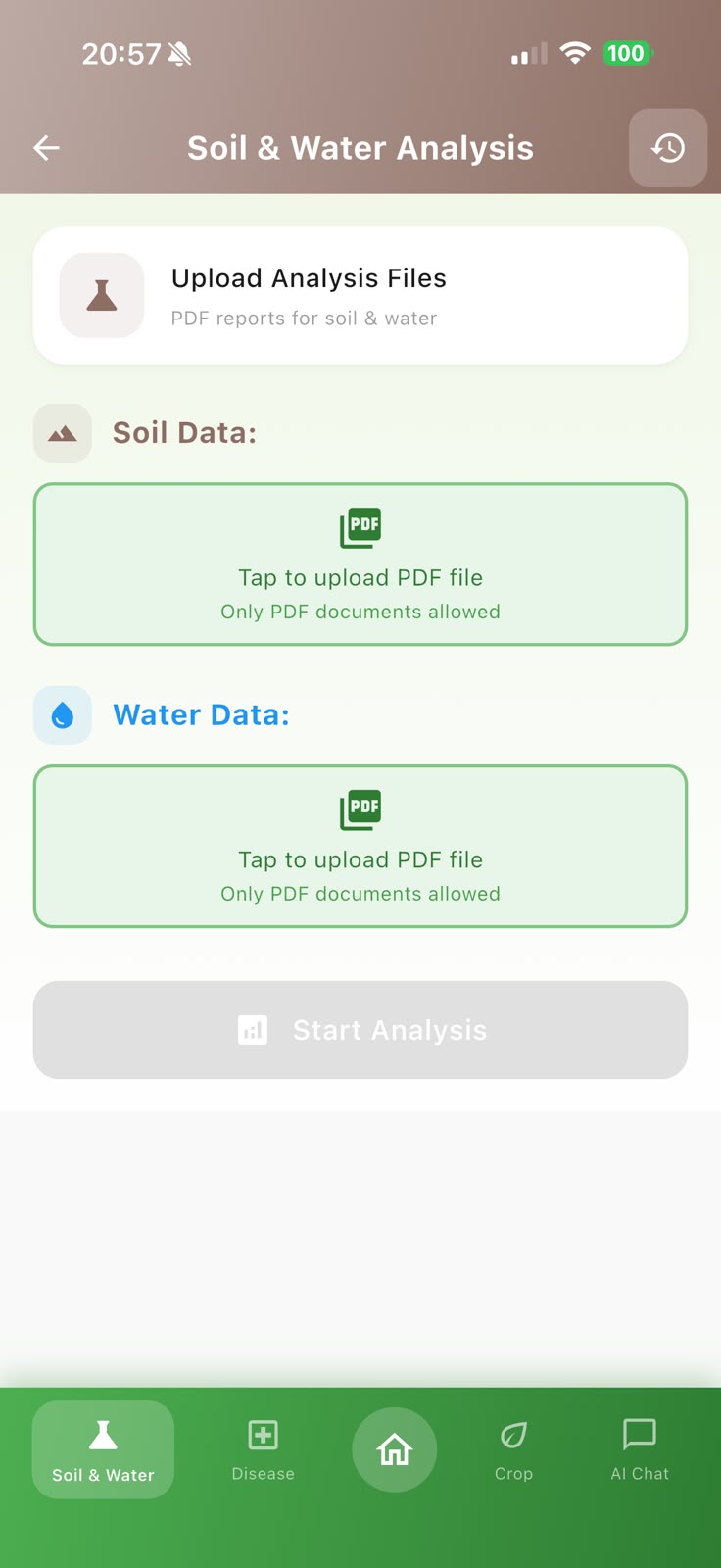
Original AgroAdvisor app screens show how field observations can move from a crop scan to a more focused review.